02 May 2016

Sliding Doors

I have this memory of being a boy and my dad reciting The Road Not Taken, the poem by Robert Frost, which starts...

Two roads diverged in a yellow wood, 
And sorry I could not travel both 
And be one traveler, long I stood 
And looked down one as far as I could 
To where it bent in the undergrowth;

I feel like my life, and that of my family, has been like that of the character in the poem. We tend to take The Road Not Taken. My dad, an American, ended up in West Africa for a big portion of his life; my mom, a Ghanaian, ended up in America for a big portion of her life; me, a who-knows-what, had now ended up in Scotland for the past 6 years.

When I was a university student, I joined a student organisation for students who had some sort of mixed-raced background. I met several trans-racial adoptees as part of this organisation. It was from meeting these people that I decided I wanted to adopt a child at some point, and I feel forever grateful for the friends I made at that time in my life, who were adopted, because they opened my mind up to something I hadn’t spent a lot of time thinking about before then.

Although I had known a few adopted kids growing up, this was the first time I really got to hear the stories of adopted children; where their lives were before they were adopted and where they ended up, at the time I got to know them.

I often wondered about the lives of these friends of mine. Particularly, I wondered what their lives would have been like if they had not been adopted, or if they had been adopted by someone other than their parents. I never felt comfortable enough to ask these friends (or their parents) their thoughts on this; I thought it was too prying and kept those thoughts to myself.

Now, I find myself on the other side of that coin. I’m a parent of an adopted kid, and over the past 6 months, I’ve thought a lot about our kid’s life with us and what it would have been like if we had not been in the picture.

I hadn’t really thought too much about our kid’s possible ‘Sliding Doors’ lives until we started travelling with our kid, and my witnessing our kid finally getting to see the lives we had lived that she was not a part of before she came to live with us. Lauren and I have very diverse backgrounds (as you can see from our wedding photo) and it’s been interesting to see someone so young exposed to our family diversity in such a short time span.

someone told my dad that this was the most diverse wedding photo they had ever seen
Because of diversity of locations of our family, our kid’s life has been a whirlwind over the past 6 months. She’s made 4 trips to 3 continents in that time; that’s insane! It’s while on these trips that I wonder where our kid’s alternative lives might have taken her. 

Amsterdam
In the past 6 months, our kid has walked over canals in Amsterdam, has been a few feet from meandering Ghanaian cows, crossed the Golden Gate Bridge, seen the Grand Canyon. She’s fallen down a flight of stairs in Maryland, eaten freshly roasted tuna from a market woman in Ghana, played in a pool in Palo Alto, and sat on the shoulders of a man more than twice her height in Phoenix.

Baltimore, Maryland
She has received hugs and high-fives from family that didn’t know she existed until a couple of years after she was born. These tokens of affection have come from family and friends who are from all over the world; people that she can say are her family and friends of her family.

Koforidua, Ghana
Our kid is now like the rest of our family. Our kid’s life is like that of the character in the Robert Frost poem. In the end, she has ended up taking a life less travelled by the majority of kids adopted in the UK. And I would hope that ‘that has made all the difference’.

In Antelope Canyon, Arizona

20 March 2016

The Scottish Gaelic Medium School Diet

We had always planned on sending our kid to the Gaelic Nursery/Primary School that opened up in town a few years ago. Although I'm not sure what the benefits are of learning Scottish Gaelic, specifically, it is widely known that learning a 2nd language (even if it's a language that's only spoken by 60,000 people) is beneficial.

Our kid started going to the nursery school in August and getting her to and from school was 'Bus Hell'.

Getting a 3-year old to walk to a bus stop when you have to catch a specific bus, by a certain time in the morning, is just the start. Then there was the waiting. The waiting for the bus to take her to school. The waiting at the school when the bus got there far too early (the next bus would get us there late). The waiting for the bus to take me to work (which I seemed to always just miss, even though there are at least 3 buses that can get me from near her school to near my work). We would leave home at 8 and I would get to my office at about 9:45. Nearly 2 hours of bus-related activity, every morning.

Then there was picking her up.

I work from 10:00-1:30 and our kid gets out of school at 3:00. I had the option of walking home (30 minutes), being at home for about 15 minutes (not enough time to do anything), then heading out to catch a bus to her school. Alternatively, I could go straight from work to her school on the bus and then have to figure out what to do, in a part of town that has very little to do, for an hour.

After a month of this, I thought, let's get a bike and a child's bike seat. OMG, that's the best idea I've had in the past year (or two, or three).

Now, we leave home at 8:30, get her to school at 8:45, and I'm near my office by 9:20. Our kid has time to watch Sesame Street before heading off to school; I have time to go grocery shopping before work. At the end of the work day, I bike home and am home before 2 and don't need to leave to pick her up until 2:45; it's amazing how much housework can be done in 45 minutes (and it's work I don't have to do at 9 pm anymore).

All I can say is, the Bike Heaven has put Bus Hell to shame. I love the bike and all it does for my life.

I used the call the gym my church. I used to go every Sunday morning, being there right when it opened at 9, with the other (few) Sunday morning gym goers. I would also go a couple of times after work, during  the week. I love the gym.

I'm not someone who goes to the gym to get buff; it's where I go to clear my head and get some exercise while doing it. That being said, I weighed myself almost every time I went to the gym (we don't have a scale at home) and had a goal. I typically hovered at about 77-78 kg (about 170 lbs). I had this goal of getting down to 75 kg, but never seemed to.

Now, with our kid, I don't get to the gym anywhere near as often as I would like and have even considered cancelling my membership. If I’m lucky (and I rarely am), I can go two times in a one week. More often, it’s once a week, or once every two weeks.

I hadn’t weighed myself at the gym for months. The combination of me not going much for a while, the scale being moved from where it used to be (and me not bothering to find out it’s new location), and me feeling like I didn’t want to weigh myself because of my lack of gym-going.

Finally, at some point in January, I discovered the new scale location and weighed myself. I didn’t believe the electric scale. I got off of the scale twice to weigh myself again, and again. I left the gym assuming there was something wrong with the scale. It just can’t be.

A week or two later (the next time I made it to the gym) I weighed myself again. WTF. Either the scale was still broken or I had lost over 5 kg. Me, the guy who since the age of 14 had this idea that running would help me lose weight (running has never worked for me) had lost that much weight by not particularly trying; I lost the weight from riding a bike around town.

Until that point, I didn’t realise just how much bike riding I do in a given day. Here’s the breakdown:

I ride our kid to school (1.8 miles, mostly downhill):


I ride myself from our kid’s school to work (2.5 miles, mostly uphill):


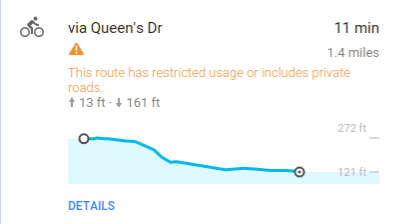
I ride from my office to our flat when I leave work (1.4 miles, pretty much all downhill)


I ride to pick our kid up from school (1.8 miles, mostly downhill).


I ride our kid back home, on a slightly different route than going to school (1.9 miles, mostly uphill).


I ride 9.4 miles a day. You tack on taking our kid to weekend classes and I ride a bike well over 50 miles a week.

I’m not a ‘cyclist’. I don’t have much ‘gear’ or a cool bike. Although I’m amazed at how many people with ‘gear’ and cool bikes I blow by on my uphill ride to work everyday; me with my kid’s bike seat on the back and my work trousers (I do have dedicated bike shirts, but not really 'bike' shirts, just shirts I only wear when I bike). Either these people are really taking their time getting places, or they’re posers, but I digress.

I’m not someone who ever set out to log hundreds of miles on a bike; I just wanted a little more time to get stuff done and a little less time dealing with Bus Hell.

So, the moral of the story: if you want to lose a lot of weight, put your kid in a Gaelic Medium school. That’s the point of this whole thing......isn’t it?

03 January 2016

Culture Shock

After not being in the US for 2 years, I expected some degree of culture shock. I got the usual comments from people about making sure to drive on the right side of the road. This was heard often enough that I don’t know how much people were joking and how much they thought that transition would be hard. Being that I barely drive in the UK, that thought never even crossed my mind as an issue and had no problem driving, even driving 3+ hours in heavy traffic and rain, on 4 hours sleep, from Dulles Airport to Towson.

That was my first moment of culture shock; the traffic and roads. While driving wasn't hard, you tend to forget how much traffic there is in parts of the US. We were moving less that 5 miles an hour on a freeway that had 4 or 5 lanes (each way). I kept thinking how different this was that my usual rush-hour travel, of me riding a bike through slow traffic on a road that has one lane each way; traffic that is only delayed by red lights, not unseen ‘traffic’ that led to the crawling pace we were moving on, on a major freeway.

The other culture shock I was prepared for was the diversity. When I go to a shopping centre in Edinburgh with our kid, I’m not the least bit surprised if my kid is the only brown-skinned, curly-haired person in the entire shopping centre. In Towson, I’d be a bit surprised if our kid is the only brown-skinned, curly-haired kid in the line to check out. This isn’t shock, really; it was a welcome relief to not stand out so much when I was out and about. I don’t know how much our kid appreciated not being the only brown kid in stores, in playgrounds, in the children’s museum we went into. She never made any comments about it, even though she comments about people’s skin colour in the UK, but I’m hoping she appreciated the diversity.

Because most of the trip was spent visiting people we knew, there was no culture shock there. I felt like the rest of the trip was spent buying stuff, so I had a number of shopping-related shocks.

I forgot about sales tax. In the UK (like much of the world), taxes are built into the price, so the price you see is the price you pay. I’ve never liked the US system of showing you a price, then tacking on sales tax after the fact, especially since sales tax differs from state to state. Something that says it costs $4 could cost you $4 in one state, $4.28 in another and $4.40 in another; it’s annoying.

I was in Safeway and saw something for $5. Sweet, I thought, that’s a good price, so I go to the self checkout and am told it’s $5.30. $5.30 is not a bad price for what I was getting, but I didn’t have any coins, and didn’t really want to accumulate coins on this trip. In that transaction, I got back 70 cents of coins, which I then had to figure out how to use up. I spent more time on this trip trying to use up unwanted coins (primarily on sales tax) than I had planned.

Our kid doesn’t always choose the right time to let us know she needs to do a poo. It’s happened several times while I’m in the queue at the grocery store and, most notably, while we were about to board a plane from Dublin to Washington DC (she said she couldn’t hold it until we got on to plane). Anyhow, on our first trip to Target, she and I were separated from Lauren when she announced that she needed to do a poo. I said what I almost always say when she says this in public, ‘Right now?!?!’. I started looking for a ‘toilet’.

I asked the first employee I saw ‘Could you tell me where the toilet is?’. The response I got was given with an eye-brow-raising-how-dare-you-say-that-word-and-what-the-hell-is-wrong-with-you look: ‘You mean the bathroom?!?!

Right. The bathroom. Not a word I use much in the UK, and I didn't appreciate the guy's tone.

I know some people who are into guns and gun ownership. I don’t think these people are crazy gun people, or anything. I just can’t relate; I feel kind of the same way about Instagram. I just don’t get it.

Because of this, I had forgotten that one could go into a Walmart, and not far from where you can buy a kid’s bike, you can buy a gun. It’s not sitting out for anyone to pick up, but you could buy your kid a bike, and a gun for yourself, at the same time. I actually took a picture of the gun sales area, but it came out a little blurry, so I won't post it here.

Living in country now where guns are basically illegal, this sort of thing, and the ‘No Guns Allowed’ sign on a door to a Mall entrance (right next to a kid’s play area, I might add), are a bit unnerving. When I lived in the US, this sort of thing didn’t really strike me as odd, but on this trip, it was a bit scary to see a ‘No Guns Allowed’ sign as I was leaving the mall with our kid.

My dad likes ice cream. Who doesn’t? But the level that my dad likes ice cream is at a slightly different level than most. Before we left, I told Lauren that I thought he would have at least 4 different types of ice cream when we arrived at his house. He didn’t disappoint: Chocolate ice cream, Vanilla ice cream, Pumpkin Pie ice cream, a kind of ice cream called Waffle Cone, and Lime Sherbert (which is basically ice cream).

You don’t get ice cream at the cheapness and variety in UK grocery stores as you do in the US. Yes, I can pay a lot for some interesting Ben and Jerry’s flavour, but the store brand/generics in the US have things like Moose Tracks and Peanut Butter Swirl (I love those two flavours BTW).

At one point, I thought I would just check out the ice cream aisle in a store and was bowled over by the variety (and that an entire side of one aisle was all ice cream-related products). That’s the kind of shock I wish would make it’s way across the pond a bit. I could really go for some Mouse Tracks right now, but I can’t. I’m in the UK.

There were several times on the trip where discussions were had about if we want to live in the UK for the foreseeable future, or if we plan to move back to the US at some point.

On my last trip to the US, when we left, I felt kind of sad. I felt that I belonged more in the US than the UK. This time, I didn’t feel that. I wasn’t jumping out of my chair to come back to the UK, but I wasn’t saddened by it either.

I don’t know how much of this has to do with living here longer now, having a British kid, or what. Ask me which place I would rather live right now, and I can’t give you an answer. I honestly don’t know.

18 December 2015

Life, Death, and Christmas

Death


Our kid: Why did Grandma Shirley die?
Me: She had a bad boo-boo in her tummy.
Our kid: What did she say?
Me: ‘Oh, no, I have a bad boo-boo in my tummy’
Our kid: What did you say?
Me: I was sad.
Our kid: What did you say when she died?
Me: I was very sad.
Our kid: Did you cry?
Me: Yes.
Our kid: What did Mommy say?
Me: She was sad.
Our kid: Did she cry?
Me: Yes.
Our kid: What did Grandpa Shirley say?
Me: He was sad.
Our kid: Did he cry?
Me: Yes.
Our kid: What did Grandma Shirley say?
Me: .....she didn’t say anything.
Our kid: Why?
Me: Because she had died.
Our kid: Why did she die?


Our kid likes to talk about death. She started asking about my mother’s death a few months ago. I teared up the first time it happened. Other times, I can’t help but chuckle, especially when it gets circular the way the above sample does. She doesn’t understand the concept of death and the other day we had a conversation about my bike light’s ‘death’.


Christmas


As a child, like many children, I liked Christmas. I think kids like the flashiness of it and the gifts. As I got older, I liked Christmas less and less. For one, I don’t care much for flash, but I also grew to see 25th December, not as Christmas, but as my mother’s birthday. I always felt she got a raw deal because, other than her immediate family, no one cared about her birthday because it was her birthday; they cared about it because it was Christmas Day.

As an adult, I focused more on my mother’s birthday than Christmas. I stopped wanting any kind of gifts for myself. It got to the point where the only gift I would get for someone in December, would be my mother’s birthday gift. Christmas became this thing that happened to be on my mother’s birthday, not my mother’s birthday happening to be on Christmas.


Life


My mother’s birthday in 2009 was the worst 25th December I’ve had. My mother had been diagnosed with cancer a couple of months earlier and I knew she wouldn’t make it her birthday in 2010. I was in California, nursing a cat that had just had surgery that cost me a month’s salary. My mother was on the other side of the country, in Maryland. She would only make it a few more months.

The only thing I remember of my mother’s birthday in 2010 was walking along a sidewalk in Mesa, Arizona, by myself, in tears. I remember nothing else of that day. I’ve dreaded 25th December in the years that followed.

I’m looking for a word that is close to ‘hate’, but not quite there. That’s how I’ve felt about Christmas for the past several years. It all reminds me of my mother. Because of this, I’ve disliked decorations, lights, any kind of Christmas event where people gather. The only people I want to spend time with in recent Decembers have been my family.

When someone is alive, you don’t realize just how and what their death will affect in your life. I became Mr. Anti-Christmas after my mother died. I didn’t want to be that guy, but there I was, looking forward to January, not for the new year, but for all the decorations to be put away and the celebrations to be over.

Now I’m at a stage where our kid likes Christmas. We have gone to the Edinburgh Christmas Festival (I’m not sure the official name, but that’s what we call it in our house) multiple times. She really likes Christmas trees and cards and decorations. I’ve had to change my tone a bit about Christmas.

For the sake of our kid, who was born exactly 29 months after my mother died, who seems to want to talk about my mother’s death so much, I have to separate my mother’s birth and Christmas.

It’s hard. But I’m trying.

30 October 2015

Half-life

Half a life ago, I was picked up by two people I hadn't known very long. They put me in a car and drove off; I left the only home I’d ever known. I slept on the drive back, and didn't seem too worried about what had just happened. They took me to their small flat, took me outside that afternoon and we looked at a cat.

Half a life ago, my life drastically changed. I went from a family of four other people and a dog to a family of just two other people, and no pets at all. I went from a family that spoke with the only accent I’d ever known to a family with a very different sounding, foreign, accent.

Half a life is a long time, and I'm not sure how much of that first half I really remember. Was I really in that house with four people and a dog? What was it like to live there? What was it like to run through the hallway in that house, play in the living room, and ride in their cars?

My life now has a much smaller hallway, a much smaller living room, and I don’t remember the last time I rode in a car; we ride buses, if anything, where I am now. We have a big park I can walk to in a few minutes; the park where, half a life ago we looked at a cat.

Today marks the day when our kid has spent exactly half of her life with us.

There are times when I feel like she’s been with us forever and there are times when I feel like I don’t know her at all.

Who our kid is and who our kid was are two very different things, and I often wonder how much she wonders about her first half of life.

She’s no longer the kid with the thick Scottish accent who would say ‘Wee’ before just about everything ‘Wee car’, ‘Wee man’, etc. She’s not the kid would say ‘Ta’ on a regular basis; getting her to say ‘please’ and ‘thank you’ have been a bit of a struggle as of late.

She is a kid now, who gets so excited at the prospect of going in a car, that the first 30 minutes of a car ride is a constant stream of ‘We’re in a car!’, or some variation of that. She’s a kid who can tell you (with some help) what bus we take to preschool or to mommy's office. She’s a kid who, I wish we could provide a longer hallway to, so she can run like crazy, because running outside at this time of year is not my idea of fun.

I think a lot about who our kid will become; if she’ll be the kind of adult who wants to know about her life before us or the kind who just doesn't care. Will our kid become an adult who will wonder about the life that might have been or mainly think about the life they have? As I sit and write this now, I don’t have a strong feeling one way or the other. There is a part of me that hopes that, when she’s older, she’ll want to go on a mission to find out where her genes come from and there’s another part of me that worries she’ll want to do just that.

Although the past half of her life has been one of the more trying times of mine, the joy I have felt has been so much more greater than anything bad. The memory I have of her seeing that cat on that first afternoon, or any animal on any day, is far stronger than any memories I have of her worst tantrums.

The week before our kid came home with us, we were walking with her and her foster father, on a windy day. One of the first things I learned about our kid was on that day, when he said she loved to stick her face into the cold wind.

Just the other day, our kid asked ‘Daddy, did I like the wind when I was a baby?’ I told her that she did. She then said she wanted to pretend to be her as a baby and I would be me; I obliged, because it’s pretty easy to pretend to be myself. She closed her eyes, and stuck her face forward into the driving wind and made what she felt was a happy baby noise. I couldn't help but chuckle, being reminded of one of the first things I learned about this kid, and had the same thought I had half her life ago. ‘Man, this kid’s really Scottish.

I don’t know what’s in store the next third of our kid’s life, or the quarter after that, or the fifth after that. I just hope that all of those portions are filled with better times than worse.


17 August 2015

5 years in the EDI - wow!


Today marks 5 years since I arrived in Edinburgh.

It's weird to have lived in a place for this long and still feel like a newbie several times a week. That's the big difference between relocating within a country (which I did in the US several times) and international relocation. I still don't know how to pronounce names of places; a couple of weeks ago, I had to ask a coworker how Oban is pronounced and every time I am in the vicinity of Restalrig, I have a feeling that the way it sounds in my head is not the way it's actually pronounced.

I do use my not sounding like a native Scot to my advantage from time to time, like when someone stops me in the street and wants me to donate to some cause; 'I'm not from here' I say, and keep on walking.

That being said, in many ways, I feel more a sense of belonging here than I ever thought I would.

Lauren and I in June 2010; 2 months before moving to Edinburgh
I was at a Fringe event the other day and we were asked where people were from. Every time I answer 'Edinburgh' to that question, I don't think the asker is satisfied with my answer. But what am I supposed to say? I'm not an American tourist; I live here. More often than not, I'm more 'from here' than the person asking the question.

I never thought I would like it here. Edinburgh is the whitest place I've ever lived (by far) and many a US visitor we've had have commented on its whiteness. Because of this I think it's so odd that the whitest place I've ever lived is the place where I've had the least personal experiences of racism - I can't think of one in the last 5 years (in Edinburgh); I've had a few in the past 5 years when I've gone to the US.

I never thought Edinburgh would be home, and it still doesn't quite feel like home, but it's close. We own a flat in the city, we have a Scottish kid, with a popular Scottish name, who has spent all but a few days of her life in Scotland.

That being said, I do miss parts of being in the US. I miss Target and Trader Joe's and decent Mexican food. I miss the feeling of belonging when I speak to a stranger and not the automatic assumption that I'm not from here. I miss not being the only brown person when I'm in a room of 200. I miss wide roads and playparks/playgrounds that have toilets (I don't get why the playparks in Edinburgh don't have toilets - it drives me crazy!). I miss watching College Football on Fall Saturdays and College Basketball in March.

I do miss those things.

I don't miss the racism I experienced, and the endless political arguing that goes on in the US. I don't miss the reliance of having a car, or driving on those wide US roads at 20 miles per hour. I don't miss calculating sales tax and I don't miss baseball. I don't even miss US weather - I can't believe I just said that, but it's true.

I don't know if we will be here in 5 years. I assume we will, but who knows? I've called myself a global citizen, so I'm sure that if we're here, or somewhere else, I'll be happy enough - I'm adaptable.

Picture taken by our kid in July 2015

19 June 2015

Citizenship

I'm not someone who claims to care a lot. As a university student, a friend of mine once said that if I wrote a book it would be called 'I don't give a rat's ass'. I'm the guy who, as soon as I pick up a telemarketing call, say 'I'm not interested in what you're trying to sell me' then hangs up if they attempt to continue with their spiel.

The one thing I do care about, to the extreme, is my family. So, the passport situation we went through with our kid over the past several months really bothered me.

I should say, if you 'don't give a rat's ass' about citizenship adoption law, stop wasting your time, and stop reading this - you're not interested in what I'm trying to sell, so hang up now.

What I've taken away from the passport situation is just how interesting and weird citizenship is. 

Almost exactly 5 years ago, I wrote a blog about being a global citizen and how through my experience in life and family, I had a more global experience than most. How, if my parents had wanted to, I probably could have had tri-citizenship. This was just about the opposite experience we thought our kid would have, when people - including an immigration lawyer - said there was a good chance our kid was stateless. 

Stateless. Nationless. A person who is not a citizen - in the legal sense - of any country. Yes, the child of the 'global citizen' might be a citizen of nowhere. I don't know what the opposite of a global citizen would be, but our kid would be that. A stateless person can't get a passport, can't leave the country they're in, and depending on where they live, receives no benefits of being a citizen of a country, because they have no country they can call their own. Stateless.

Citizenship is weird. What I'm about to write is what I think I know about citizenship, but I'm no lawyer, so I could be wrong.

The United States of America:

The U.S. has birth right citizenship. This means, if you're born in the U.S., you have the right to be a U.S. citizen. It doesn't matter where your parents are from, you can be a U.S. citizen. To be honest (and this is not the most liberal thing to say) I don't agree with birth right citizenship. I just think there should be more than being born in a country to be a citizen of that country - live there for a year, or something. I'm imagining a case where a child with parents from Jeffersonia is born in the US then moves back to Jeffersonia at one week old and never sets foot in the US again - I don't think that person should be a US citizen, but I digress.

A tie-on - sort of - to U.S. birth right citizenship is this: if, when you are born, at least one of your parents is from the U.S., you can claim U.S. citizenship anywhere in the world you're born. I actually fall into this category. I was born in Nigeria, but my father is from the U.S - I have been a U.S. citizen since birth. I'm not completely on board with this either. If I were to never live in the U.S., and lived out my life in Nigeria, should I really be a U.S. citizen forever? I don't think so. If I had only lived in Nigeria and never set foot in the U.S., and if I had a child, also born in Nigeria, that child could, technically, claim U.S. citizenship. That doesn’t seem right to me. At some point, I think the link needs to be broken. The question is where/when. 

It gets complicated with adoption.

When a kid is born in the U.S. and then adopted, they are American, by the birth right rule. When a kid born outside the U.S. and is adopted by Americans, the kid can get U.S. citizenship only after the kid comes into the U.S. and goes through some process I still am not sure about. We happen to fall into this situation. We are Americans, who adopted a kid born outside the U.S. This is where the problems start to arise. To get our kid U.S. citizenship, we have to get our kid into the U.S. To get our kid into the U.S. our kid needs a passport of some kind.

No problem, we thought, while going through the adoption process. Our kid will, of course, be a British citizen and will be able to get a British passport….

The United Kingdom:

The U.K. does not have birth right citizenship; at least not anymore. Prior to 1983 it did, but since then, to get British citizenship, one has to show that at least one of their parents is/was also British. This is where our problems started.

We aren't British, so when I started the online passport application form for our kid, it took me on this wild goose chase, asking where Lauren's and my parents were born, when and where our parents were married, and I thought 'Why is all this needed?'. That's when I learned about the 1983 birth right rule. The online form doesn't know our kid was adopted, so by the letter of the law (which the online system follows, because it has no heart), our kid can't be British. We aren't British, our kid was born after 1983; therefore our kid can't be British.

You would think an immigration lawyer would have a heart - or at least a brain - to realize that we were in an odd circumstance that the law was not designed to handle strictly as written. The lawyer said that once the kid was adopted, everything was transferred to us 'not just the good'. I didn't think much of that comment when she said it, but 'not just the good'?!? Seriously? Who says that? She then said, that our kid could not be British, because our kid's legal parents (us) aren't British. The lawyer said even she thought it was weird, but that was the case. So, according to her, by being adopted, our kid LOST her British citizenship, which, any rational person would think, sounds insane! 

Before I called the lawyer, I had spoken to someone who works at the passport office who I was passed on from 3 different people. He had given me basically the same information, saying we had to apply for her to be a British citizen before we could get her a passport. He then wanted to talk about how crazy the Super Bowl was, which had happened the night before. Thanks passport worker guy – good to see you care about people’s actual problems!

Needless to say, at this point, we didn't know what to do. We had a stateless child. Every non-lawyer/non-passport worker we told this to thought it was crazy that she would stateless - everyone thought she should be British.

After a several weeks of sitting on this, I said we should just apply. We should show she was British at birth. Our social worker got in touch with a legal expert at the British Association for Adoption and Fostering - this person agreed with every non-lawyer/non-passport person we had talked to about this. We decided to apply. Now, we just needed to show our kid was born British.

This was tougher than I thought it would be.

If we could show our kid's birth mother was British, we would be done. The obvious way to do this would be to produce the birth mother's passport, but that's not the sort of thing we had access to. Being that there was a delay in the adoption because the birth mother was contesting it, I don't think trying to contact her to get her passport info, so we could get a passport for the kid whose adoption she was trying to prevent, would be the best thing to do. So, we got her birth certificate.

Our kid's birth mother was born after 1983, so having her birth certificate was not enough to prove that she (the birth mother) was British. We had to show that one of her parents were British, to prove that she is British, which in turn would prove that our kid is British. We were able to track down the birth certificate of our kid's birth mother's father. We applied for a passport for our kid.

About a week later, we got a letter from the passport office. The birth mother's father's birth certificate was not good enough to show that the birth mother was British. Why is still a bit unclear to me, but to show the birth mother is British, we would need to produce either the birth mother's mother's birth certificate or the birth mother's father's birth certificate accompanied with the marriage certificate of the birth mother's parents. Lauren called the passport office and asked why this additional thing was needed for the father of the birth mother but not the mother of the birth mother. They gave some hand wavy answer which clearly showed that they had no idea why - it was just the way it was. Because someone said so, I guess.

We were able to get the marriage certificate of the birth mother's parents, which, with the birth certificate of the birth mother's father, showed the birth mother is British. By having the birth mother's birth certificate, along with her birth child’s original birth certificate, we could show that the child of that birth mother is British. By having our kid's post-adoption birth certificate, along with her pre-adoption certificate, we showed that that child is now our kid, with a different name.

After rereading the last two paragraphs, I'm a bit lost myself.

In proof-ish language:

We need to show our kid is British
  1. Birth mother’s father’s birth certificate + Birth mother’s parent’s marriage certificate  Birth mother is British.
  2. Birth mother’s birth certificate + Kid’s original birth certificate  Kid is British
  3. Kid’s original birth certificate + Kid’s post-adoption birth certificate  Kid is now our kid, with a different name.
 Our kid is British

Three days later, our kid’s passport arrived. So, the immigration lawyer was wrong. The Super Bowl guy who worked for the passport office was wrong. Our kid was never stateless. Our kid was British, and now had the passport to prove it.

The documentation to show that our British kid, is indeed British (and her passport)

The hour from 1:30-2:30 on 5 June 2015 is one of the happiest hours of my life. I got home with our kid and saw the envelope, not knowing what it was, then saw it was her passport. I said 'Hey, it's your passport!!!!' and gave it to her. Thinking it looked like a book, her response was 'Read it, daddy!'

I know I’ll never write a book called 'I don't give a rat's ass', but I'll gladly read an empty passport that belongs to my kid. 

So in the end, our kid, who we thought was stateless, may be, one day, a dual citizen, and like her parents, a global one.